22 Oct 2012

MULTIPLICATION


1.To do binary ,multiplicate we have 4 rules we should follow in binary multiplication as in table:

       Table 3.1.This is The Binary Number operations Rules :                                                   
                                                         
Binary Rules
Multiply
     0 x 0 = 0
                  0
         0 x 1 = 1
                  0
         1 x 0 = 1
                  0
         1 x 1 = 1
                 1


 .
   
Binary Multiplication
Binary multiplication uses the same algorithm, but uses just three order-independent facts: 0 x 0 = 0, 1 x 0 = 0, and 1 x 1 = 1 (these work the same as in decimal). If you perform the multiplication phase with these facts, you’ll notice two things: there are never any carries, and the partial products will either be zeros or a shifted copy of the multiplicand.
Observing this, you’ll realize there’s no need for digit-by-digit multiplication, which means there’s no need to consult a times table — which means there’s no multiplication, period! Instead, you just write down 0 when the current digit of the multiplier is 0, and you write down the multiplicand when the current digit of the multiplier is 1.
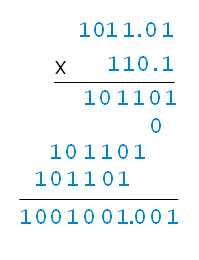
In the introduction, I showed this example: 1011.01 x 110.1. I wrote it as if you followed the decimal algorithm to the letter. Here’s how it looks if you follow the simpler “write zero or multiplicand” algorithm (it’s the same result, but with blanks representing 0s; this matches better conceptually with what we are now doing):
        Firstly to do the multiplication we must use the table 3.1 to do the Binary Number Operations Rules.


Here’s what the “multiplication” phase looks like, step-by-step:


 Steps of Binary Multiplication (Multiplication Phase Only)
Each step is the placement of an entire partial product, unlike in decimal, where each step is a single-digit multiplication (and possible addition of a carry).
In the addition phase, the partial products are added using binary addition, and then the radix point is placed appropriately. This gives the answer 1001001.001.


Decimal Multiplication

To multiply two multiple-digit decimal numbers, you first need to know how to multiply two single-digit decimal numbers. This requires the memorization of 100 facts, or 55 facts if you exclude the commutative or “turnaround” facts. These facts are usually represented in a “multiplication table,” also known as a “times table.” Example facts are 2 x 9 = 18, 9 x 7 = 63, and 1 x 6 = 6.
A multiplication problem is written with one number on top, called the multiplicand, and one number on the bottom, called the multiplier. The algorithm has two phases: the multiplication phase, where you produce what are called partial products, and the addition phase, where you add the partial products to get the result.
In the multiplication phase, the digits of the multiplier are stepped through one at a time, from right to left. Each digit of the multiplicand is then multiplied, in turn, by the current multiplier digit; taken together, these single-digit multiplications form a partial product. The answer to each single-digit multiplication comes from the multiplication table. Some of these answers are double-digit numbers, in which case the least significant digit is recorded and the most significant digit is carried over to be added to the result of the next single-digit multiplication.
For example, let’s multiply 3.87 and 5.3:
An Example of Decimal Multiplication
Example of Decimal Multiplication
There are two digits in the multiplier, so there are two partial products: 1161 and 19350. Each partial product has its own set of carries, which are crossed out before computation of the next partial product. Here is the multiplication phase, broken down into steps:
Steps of Decimal Multiplication (Multiplication Phase Only)
When the multiplication phase is done, the partial products are added, and the decimal point is placed appropriately. (If there were any minus signs, they would be taken into account at this point as well.) This gives the answer 20.511.


This is step how to do the multipication.


21 Oct 2012

ARITHMETIC FOR COMPUTERS ( addition and subtraction)

Binary Addition:

There is four rules we should follow in binary addition as shown below:


actually,adding binary number is almost similar to adding decimal number. The different is,we use binary rule in this operation. Here i show you the steps how to solve addition of binary number.

Step 1:

Align the numbers you wish to add as you would if you were adding decimal numbers


Step 2:

Start with the two numbers from the right column


Step 3:

Add the numbers following the rules of decimal addition


Step 4:

Add 1+1 as "10". (actually it is not "ten" but "one zero"). Write "0" below and carry a "1" to the next column.


 Step 5 :Start on the next column to the left


Step 6 :

Repeat the steps 5, but add any carry. just to remind that 1+1 = 10 and 1+1+1 = 11. dont forget to carry the "1".


Ok,there is some tips that you must take note. First, don't ever forget the carry. The most important in binary addition, you just only use the digit '1' and '0'. If you find yourself using any other digit, you did something wrong!


Binary subtraction :


same as additon,subtraction of binary also must follow some rule. the rule is shown below:


We can subtract one binary number from another by using the standard techniques adapted for decimal numbers (subtraction of each bit pair, right to left, "borrowing" as needed from bits to the left).


Minuend           10110
Subtrahand  -  10010 
Difference       00100


And when a borrow is needed. Let me make you more clear. you just note that the borrow gives
us 2 in the current bit position. See this example:


Other example:


hexadecimal addition

In hexadecimal addition,if the sum number is greater than 1510, the amount of sum that exceeds
1610 will carry a 1 to the next column. Example are shown below:


hexadecimal subtraction:

There is several steps you must remember to solved hexadecimal subtraction.

step 1: convert hexadecimal to binary.

step 2: take the 2's complement of the binary number

step 3: change it back to hexadecimal number.


example:


Alright! thats all some notes from me. Hopefully you can absorb a few knowledge by this entry and don't forget to come again ya! Thanks for reading...

~posted by Nabila Huda Mohamad (B031210008)


9 Oct 2012

this blog willl be use for COMPUTER ORGANISATION AND ARCHITECHTURE assignment..

assalamualaikum,salam sejahtera,salam 1 malaysia,salam melaka maju negeriku sayang negeri bandar teknologi hijau...memandangkan belog yang buruk lagi usang ni tidak mendapat sambutan ramai ditambah pula dengan dh b'tahun x sentuh belog ni,,maka elok la kiranya belog ni menjadi landasan untuk membuat assignment...

kami telah ditugaskan untuk membuat nota2 berdasarkan apa yang telah kami belajar di dalam kuliah...segala nota2 tersebut akan dipublish di dalam entri ini...maka dengan ini,,saya sertakan sekali ahli2 kumpulan yang bakal menconteng belog buruk ini..antaranya ialah:


  1. saya-nabila huda mohamad
  2. nur syazwan bt abd malek
  3. nor farhana
  4. ilham
  5. kala devi
semoga pembaca2 yang TERsinggah ke belog ini dpt meraih sedikit sebanyak ilmu drpd nota yang kami hasilkan...terima kasih...

sebelum itu ingin sya nyatakan bahawa miss zakiah yang mengajar kami sgatttttt COMEL..sekian,wassalam...